Glue-down vs floating, and why we glue timber down every single time.
A client walked into our Rosedale showroom recently after another flooring company told them not to glue their new timber floor down. We hear that advice secondhand a few times a year, it is nearly always about the installer rather than the floor, and it deserves a straight public answer.
Two ways to lay a floor.
There are two ways to put an engineered timber floor into a home. Glue-down bonds every board to the slab or substrate beneath it with a trowelled adhesive, so the floor and the structure become one thing. Floating rests the boards on a thin underlay, fixed to each other but attached to nothing, held in place by gravity, with a movement gap hidden behind the skirting at every wall.
Neither method is new and both are everywhere, which is exactly why the choice gets so little scrutiny: most companies quote the method they prefer to install and never mention that a decision was made. For engineered timber across Auckland we glue every floor, every time. The rest of this post is the why, including the honest part about when floating genuinely is the right call.
The knock test.
You can hear the difference between the two methods in any hallway. Crouch down and give a floating floor a firm knock: it answers with a hollow drum, because you are knocking on a board suspended over foam and air. Knock a glued floor and you get a dead, solid note, the same answer the slab itself would give. Your heels, a dog’s claws and every dropped toy run that same experiment all day long, and the room below a floating floor hears more of all of it.
Feel follows sound. A floating floor flexes under each step because it has somewhere to go, and years of that constant working is what opens squeaks and clicks at the joints. A glued floor has nowhere to move, so it feels like solid timber underfoot, which is the thing everyone bought a timber floor to feel like in the first place.
Wide boards make it non-negotiable.
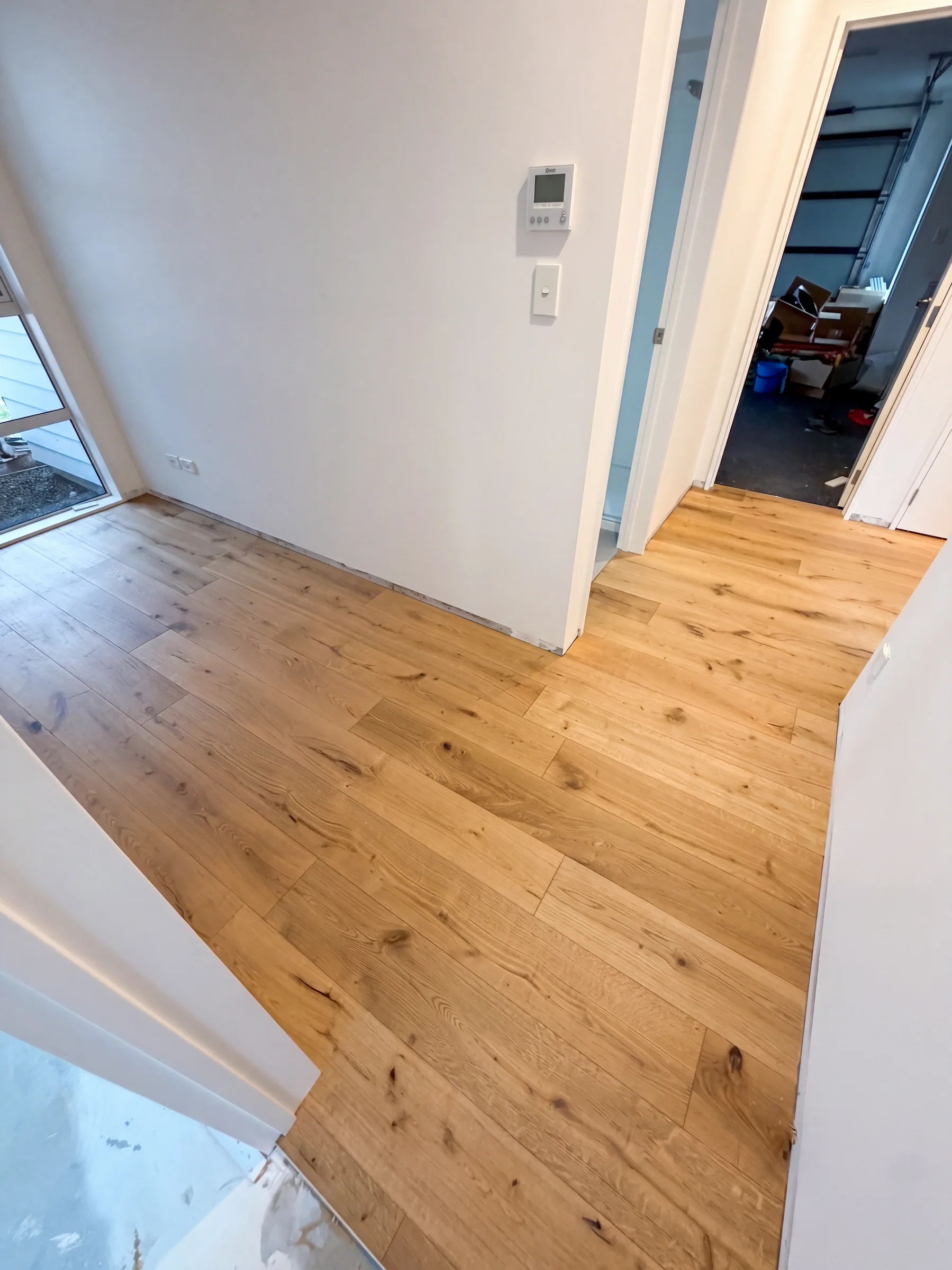
The wider the board, the more it wants to move with every swing in humidity, and the more important full bond becomes. Our 260mm wide board is bonded to the structure along every centimetre of its back, so seasonal movement is restrained board by board rather than accumulating across a floating raft. It is the only way we would lay a board that wide, and What makes a quality engineered timber board covers what that width buys you in return.
Stairs settle the argument on their own. Treads and nosings cannot float; they are fixed, always. A glued home is one continuous method and one continuous feel from the front door to the top step, instead of a solid staircase meeting a drumming landing.
When floating is the right call.
Floating is not a scam. It is a method with two honest use cases. Click-together laminate is engineered to float: the dense core, the locking profile and the underlay are designed as one system, which is why our laminate floats and our timber never does. And a floor someone genuinely plans to lift again, in a rental or a temporary fit-out, has a real reason to stay liftable. That is more or less the whole list.
So why is “don’t glue it down” such common advice? Because floating a timber floor is better for the installer: faster, cheaper, less skilled, and it skips preparing the slab properly. Every one of those savings belongs to the company, not to your floor. When you hear the advice, ask one question: what would you charge to glue it? The answer usually explains the recommendation.
Apartments make it a requirement.
In an apartment the method argument ends entirely, because body corporates ask for proven impact-sound numbers before they approve a hard floor, and the proven path to those numbers is glued. Our apartment build bonds MAPEI’s Mapesonic cork and rubber mat to the slab, runs ECO 995 over the mat, and glues the boards over that: a tested system that delivered a 17 dB impact-sound improvement in University of Auckland lab testing, the kind of paperwork a body corporate can actually approve.
A floating floor in the same apartment leans on a generic underlay brochure, and the room below hears the difference nightly. If you are weighing timber upstairs from a neighbour, the apartment build and its price live in the adhesive section, published like everything else.
Three questions for any installer.
Whoever you talk to, including us, these three questions surface the real decision in under a minute.
The cost objection disappears.
The one real argument for floating a timber floor is money: adhesive and preparation are line items, and at most companies they arrive as extras on a second quote. Here they do not exist as extras. The glue under every timber floor we lay is MAPEI Ultrabond ECO 995, the gold standard adhesive in our industry: a moisture barrier, a sound reducer and a lifetime-warranted bond in a single trowel, already inside the published supply and install price on every timber range.
Which leaves the comparison where it should be. On one side, a floor that drums, flexes and works its joints loose over time. On the other, a floor bonded to the house, for the price you were already quoted. With the glue in the number there is no version of the maths where floating a timber floor wins, and What a floor really costs shows the whole quote line by line if you want to check ours.
Get the straight answer.
Tell us about your space and we’ll tell you exactly how we would lay it, and what it costs installed: one number, glue included.