Caring for a pale floor.
Whitewash and pale oak floors have a reputation for being precious. In daily life it is the opposite: pale boards are the forgiving ones. Here is the honest routine that keeps them that way, drawn from the care guides we hand over with every floor.
Pale boards forgive daily life.
Most of what lands on a floor is pale: dust, sand, crumbs, pet hair, the fine haze of ordinary living. On a dark board all of it shows; on a pale board it disappears into the colour until cleaning day. Fine surface wear hides the same way. If a dark floor is honest about housework, a pale one is discreet, which is why busy family homes in Auckland lean pale so often. The flip side of that trade is covered in The dark colour rule.
What pale boards do not forgive is sitting liquid and strong chemicals. The routine below is short, and almost all of it is about keeping those two away from the timber.
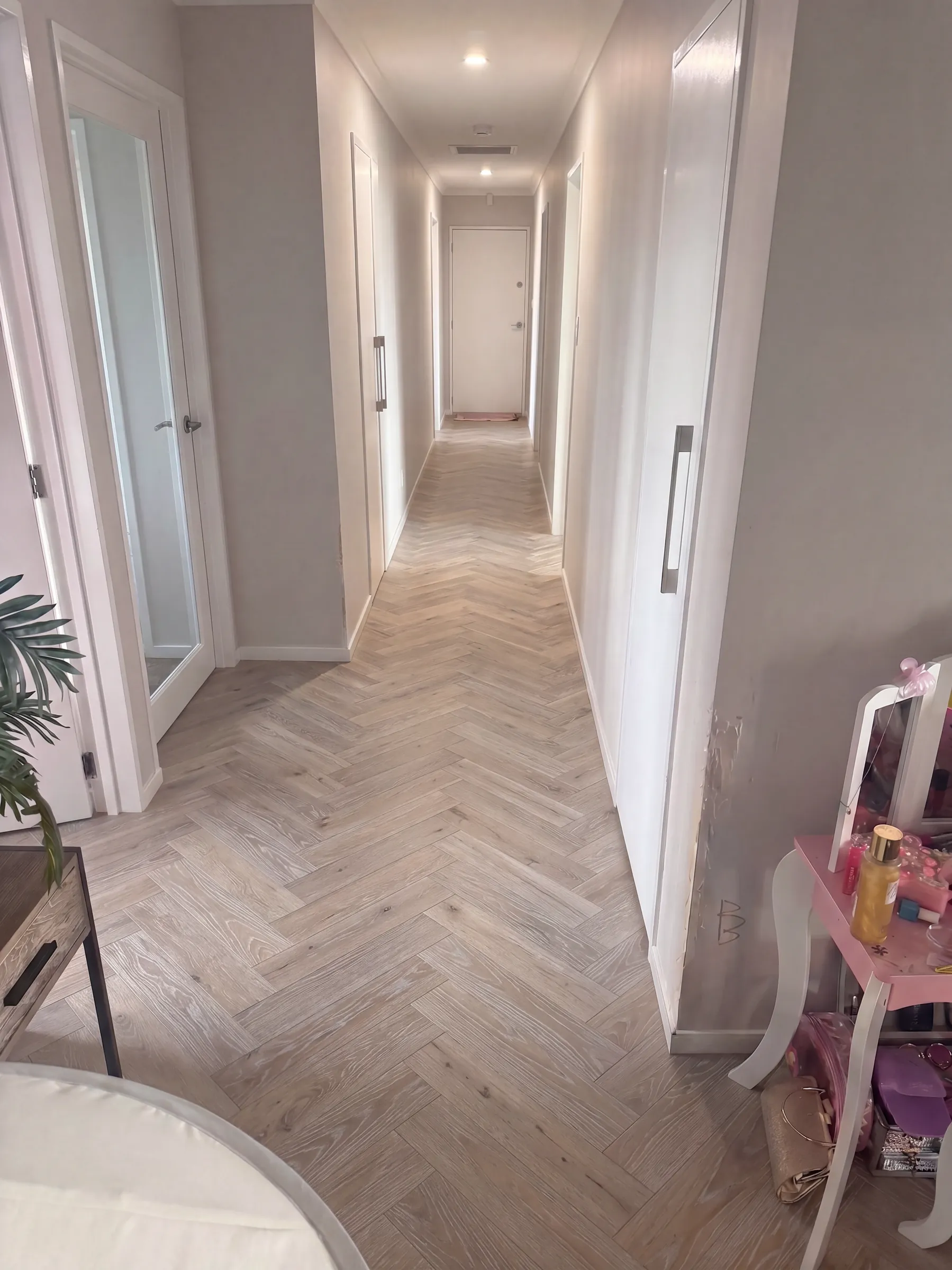
The routine, in full.
Doormats outside every entrance, so sand and grit never reach the boards: grit underfoot is sandpaper in slow motion, and on a pale floor the resulting dullness shows in the sheen before it ever shows in the colour. On the floor itself choose non-staining mats, and avoid rubber-backed, latex-backed or coco fibre mats, which can mark the lacquer.
Sweep or vacuum regularly on a hard-floor setting, and shake out the rugs in busy areas. When the floor needs more than a vacuum, damp mop with the least water that does the job, and absorb spills rather than spreading them. Skip the supermarket aisle entirely: oils, soaps, waxes and general household cleaners all leave their own films on a lacquered board, and on a pale colour a film is visible. Steam mops are not recommended at all: excessive heat and moisture can damage the floor and may affect warranty coverage.
At the doors
Mats outside every entrance; non-staining mats inside; never rubber-backed or coco fibre on the boards.
Weekly
Vacuum on the hard-floor setting, shake the rugs, and damp mop with the least water that does the job.
Spills
Blot quickly, never leave standing water. The lacquer buys you time; it does not buy you a lake.
Sunlight and the indoor climate.
Strong sun fades timber the same way it fades furnishings, and in a pale colour the change creeps up quietly. Where hard afternoon light strikes the floor, close the curtains or blinds through the worst of it, and move rugs occasionally so any change arrives evenly rather than in rug-shaped patches.
Timber also moves with humidity: big swings can make boards cup, crown or peak. The comfortable band is easy to remember because it is the one people like too: 18 to 25 degrees indoors, with relative humidity between 30 and 70 percent. An ordinary Auckland home sits inside it almost all year; the thing to avoid is the extreme, like a holiday home shut up damp for a season.
Furniture, pets and heels.
Support furniture on wide, non-staining floor protectors at least 25mm across, sitting flat: felt works well, soft casters or felt under anything that moves, and a protection mat beneath wheeled desk chairs. Before moving anything heavy, lay strips of wood or hardboard as runways, wheels or not. Dragging is the one way to put a mark in a floor that no routine can prevent.
Keep pet nails trimmed and shake the grit out of rugs where paws land. High heels and gravel-studded soles mark any floor, pale or dark; rugs in the busy runs take that traffic instead. None of this is special treatment for pale boards: it is the same list every engineered timber floor wants, with the comfort that on a pale board the day-to-day misses are the ones that show least.
The never list.
Short and absolute, straight from the care guide that ships with every floor: steam mops; wet mopping or excessive water; harsh chemicals or abrasive cleaners; steel wool or scouring pads; dragging furniture; standing water; and rubber-backed or coco fibre mats directly on the boards.
Everything else is just living. The full range-specific guides, including Oak Plank and Herringbone, stay published with every floor we sell, and the pale boards themselves, every one priced supplied and installed, from Snowfall and Whitehaven to Drift, are gathered on the light tag page.
Let’s start from the ground up.
Tell us about your space and we’ll come back with a plan and a price.