The dark colour rule.
Dark timber floors photograph beautifully and sell themselves in a showroom. Whether one will suit your home comes down to a single rule, and it is worth knowing before you fall for a board.
The darker the floor, the more light it needs.
That is the whole rule. A floor is the largest surface in a room after the walls and ceiling, and unlike them it catches light from every window at a working angle all day. A pale board returns most of that light to the room. A dark board keeps it.
Neither behaviour is a flaw. Kept light is what gives a dark floor its depth and its sense of occasion. The question is only whether your room has light to spend. A generous room with big glazing barely notices the cost. A small room with one south-facing window notices it immediately: ceilings read lower, corners go grey, and the colour that looked rich on a sample board reads heavy on forty square metres of it.
So before choosing dark, audit the room, not the board. Which way do the windows face, how large are they, and how much of the floor will daylight actually reach across the day? In Auckland the sun sits north, so north-facing living areas carry dark floors easily; rooms that look south do not get the same help.
Where the light goes.
Daylight enters through the glass, strikes the floor first, and what happens next sets the mood of the whole room. A pale oak bounces a large share of it back onto walls and ceiling, which is why pale-floored rooms feel bigger than their measurements. A dark board absorbs most of what lands on it, so the room runs on direct light alone.
Interior designers use both behaviours deliberately: pale floors to stretch small spaces, dark floors to pull a large space in around its furniture and make it feel grounded and intentional. The rule is not pale good, dark bad. It is that dark spends light, and the room has to be able to afford it.
Where a dark floor sings.
Give a dark board a large room, tall glazing and pale walls, and it does something no pale floor can: it anchors the space. Furniture stops floating and starts sitting. White joinery sharpens against it. The room acquires a baseline, and everything above it reads more deliberate.
Dark floors also carry pattern with more drama. The same herringbone that reads gentle in a pale oak reads architectural in a dark one, because every join draws a line of contrast; Picking your pattern covers that choice on its own. It is why hotels and hospitality spaces reach for dark patterned floors so often: the floor itself becomes part of the interior rather than its background.
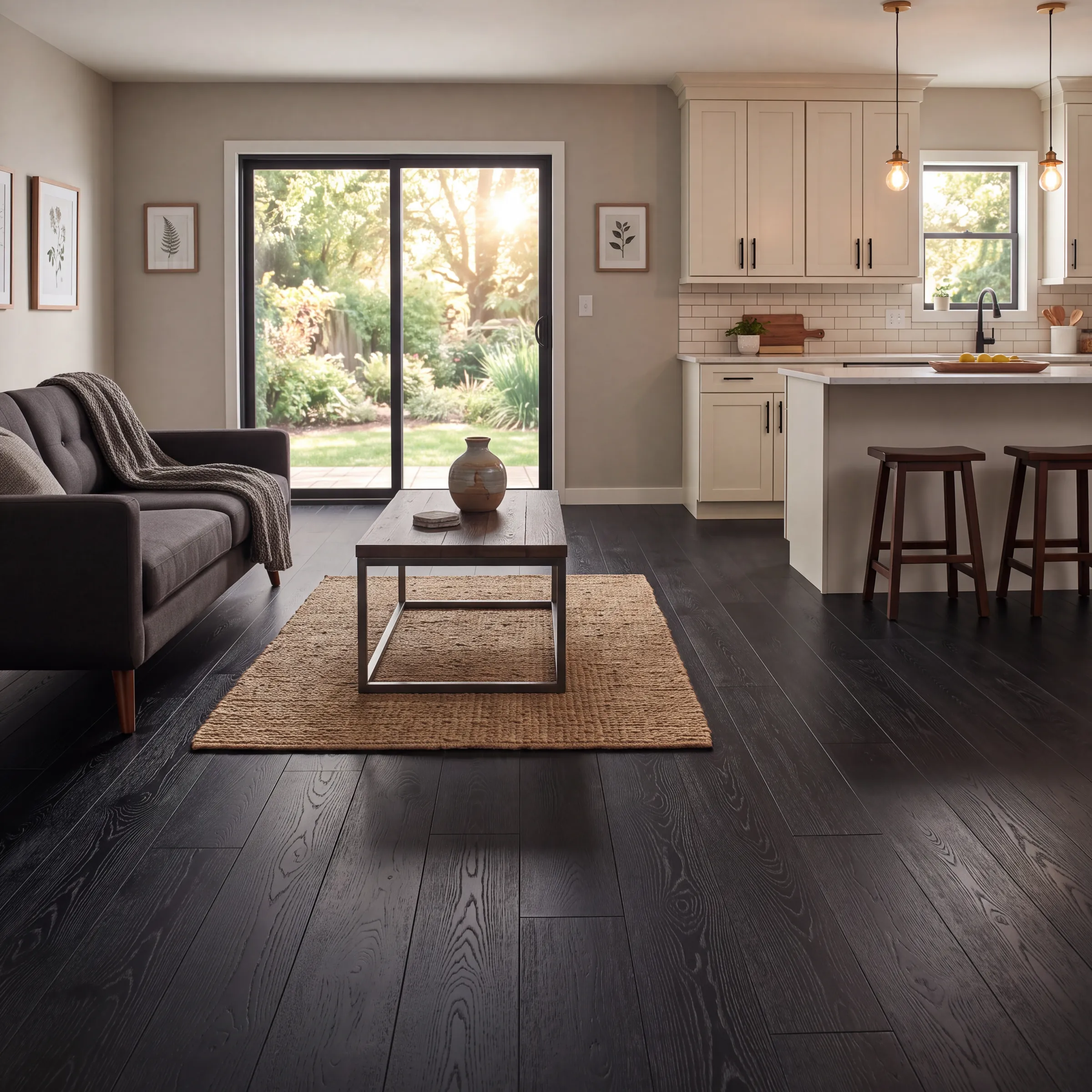
Living on a dark board.
The showroom never mentions housework, so we will. Dust, pet hair, crumbs and footprints all show more readily on a dark floor than a pale one, simply because almost everything that lands on a floor is lighter than the board beneath it. A dark floor in a busy household is not more work to own, but it is more honest about when the vacuum last came out.
Finish matters more on dark boards too. Our engineered oak boards are brushed with an ultra matte lacquer at a 3 to 6 percent gloss level, which is exactly what you want: a glossy dark floor is a mirror for every scuff and smear, while a matte brushed surface breaks the light up and quietly disguises daily wear. Texture and visible grain help the same way.
Big, bright living rooms
The natural home. Light to spare, space for contrast, and furniture that benefits from an anchor.
Entries and halls
Short on daylight but short on time spent in them: drama is welcome where nobody lingers. Grit and traffic argue for a mat at the door.
Small or south-facing rooms
Think twice. The board will keep what little light arrives. A mid brown or a pale oak serves these rooms better.
Our dark colours, and the half-step.
The full-dark boards in the collection: Tuxedo, Chocolate, Smokey and Slate Grey in Oak Plank, Slate Grey in Herringbone, and Walnut in ATS Timber. Every dark board across the ranges, each priced supplied and installed, is gathered on the dark tag page.
If the rule says your room cannot afford full dark, there is a half-step: the warm mid browns. Vintage and Caramel Roast give depth and grounding at a fraction of the light cost. And nothing beats seeing it in your own rooms: the free measure includes a preview of your chosen colour in your own space before you commit, and the showroom keeps every board on hand to borrow against your light.
Let’s start from the ground up.
Tell us about your space and we’ll come back with a plan and a price.