Why we stopped selling SPC.
We sold SPC flooring for years, and plenty of good installers in Auckland still do. We took it off our list. This is the honest account of why, what it taught us about New Zealand conditions, and what we lay in its place.
What SPC actually is.
SPC stands for stone plastic composite: a rigid click-together plank built on a core of limestone powder bound in PVC, with a printed vinyl layer on top carrying the timber look. Its headline strength is real, and worth stating plainly: the core is fully waterproof. Standing water that would trouble any wood-based floor does not trouble an SPC core.
That one strength is why the category exploded. The weaknesses took longer to show themselves, because they arrive with seasons and years rather than in the showroom. We found them the way installers do: on the other end of the phone.
The New Zealand sun problem.
Vinyl moves with temperature far more than wood-based boards do. That is simply what plastic does. Now give it the New Zealand treatment: our harsh sun, pouring through the wall of glazing every modern Auckland home is built around, onto a dark floor behind a closed slider. That floor gets hot enough to be uncomfortable to stand on, every clear afternoon, year after year.
In our experience, that cycle is where SPC gives up: planks expand against each other, joints stress, and floors that lay flat in winter cup and peak in summer. The industry knows it too. Read the fine print on most SPC warranties and you will find direct sunlight and heat damage excluded, which tells you exactly where the category expects trouble. We stopped selling the problem instead of arguing with the fine print.
The other reasons.
None of these alone would have retired SPC from our list. Together with the heat problem, they settled it.
Hard and cold underfoot
A stone and plastic core feels exactly like it sounds, with a hollow note to footsteps. A wood-fibre core walks warmer and quieter.
No path back from damage
A gouged vinyl layer cannot be sanded or refinished. The fix is tearing out planks, and matching a discontinued print years later is a lottery.
A race to the bottom
SPC quality varies wildly between factories, and the price pressure runs downward. With a thin printed layer, you cannot see the difference until it fails.
What we lay instead, and why.
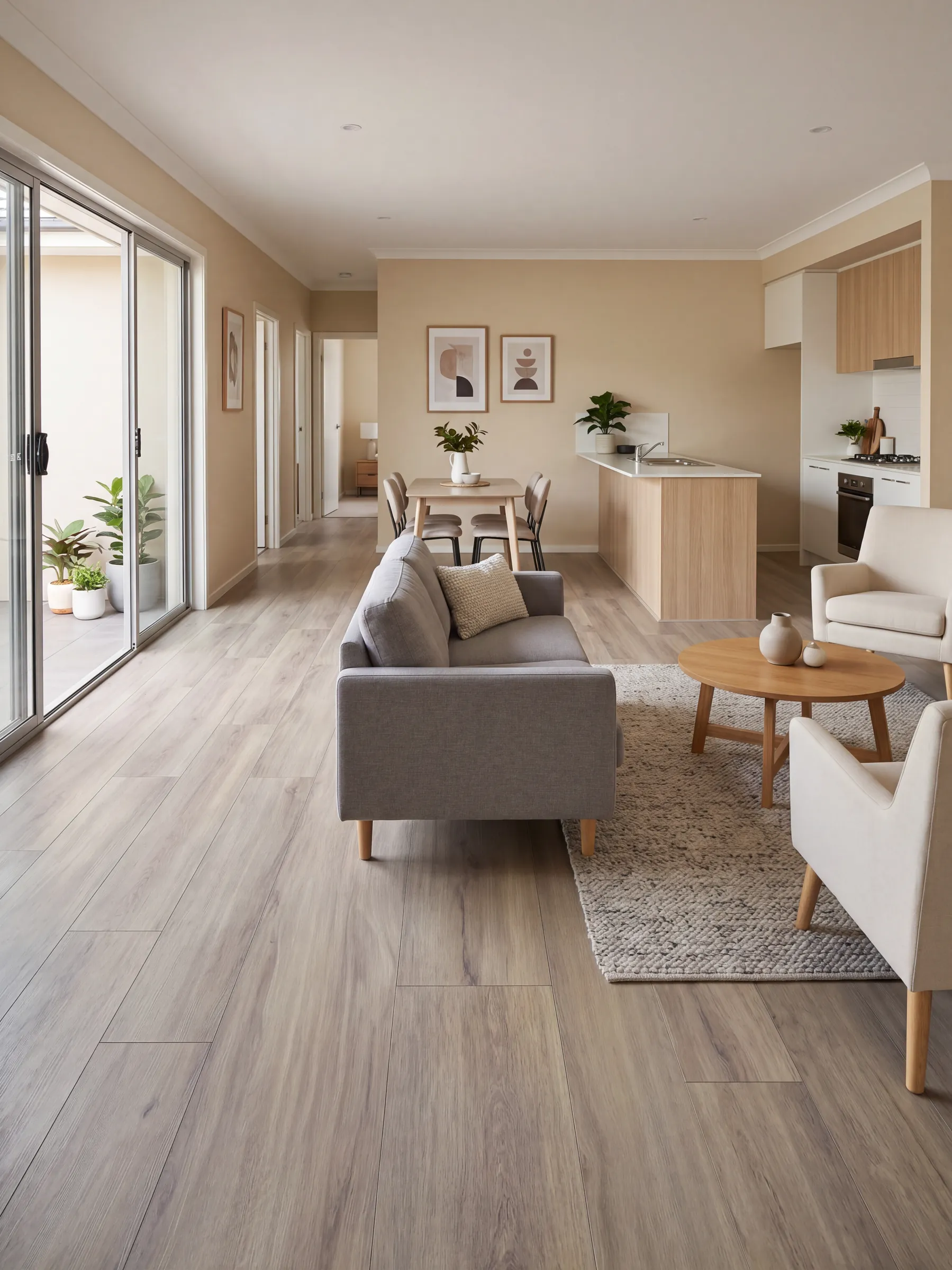
For the budget end of our collection we chose a 12mm Laminate on a dense HDF wood-fibre core: more than twice the thickness of a typical SPC plank, warmer and quieter underfoot, and dimensionally settled in the rooms New Zealand actually builds. It is water resistant for 48 hours rather than waterproof, and we are upfront about that trade: for how we handle kitchens and bathrooms properly, see wet areas.
The numbers it carries: an AC4 commercial wear rating, suitability for underfloor heating, an E0-equivalent emissions result, and FloorScore, GREENGUARD Gold and FSC certification, all on the published spec sheet. $75 per square metre supplied and installed, excluding GST. And where the budget stretches, engineered timber such as ATS Timber gives a real oak surface from $139 per square metre; What a floor really costs lays the whole pricing model out.
If you already have SPC.
Plenty of SPC floors live long, happy lives, especially away from big glazing. If yours is down and you want it to last: close curtains or blinds where hard afternoon sun strikes the floor, keep a consistent indoor temperature rather than letting a shut-up house bake, and make sure rugs are not trapping heat on sun-struck boards. The expansion gap under your skirtings is doing more work than you think; never pin the floor down through it.
And when a plank does fail, bring a spare or a photo of the print name to anyone you call. If it cannot be matched, that is usually the moment to talk about what comes next, and we are happy to be that conversation.
Let’s start from the ground up.
Tell us about your space and we’ll come back with a plan and a price.