Engineered vs solid timber.
The question behind half the conversations in our showroom: real solid timber, or engineered oak. The answer we give is engineered, every time, and this is the measured case for it: movement, the modern slab, sanding life, the oak itself, and what each path costs to live with.
One piece of oak, or layers that hold each other.
Timber moves with moisture, and the movement is recorded, not folklore. The US Forest Service’s Wood Handbook measures oak shrinking roughly twice as much across the growth rings as along them, with a tangential dimensional change coefficient near 0.0037 per percent of moisture content. Run that over a 190mm flat-sawn solid board moving through the 8 to 12 percent moisture band NZS 3602 sets for flooring in a heated home, and a single board can change width by close to 3mm. Auckland works the timber harder than most places: NIWA’s climate normals put the city’s mean morning humidity near 82 percent, while a heated winter lounge runs far drier, and an unprotected solid floor swings between the two every year.
An engineered board is built so the movement cancels. The solid oak wear layer sits on a core of crossed plies, each layer’s grain running against its neighbour’s, with a backing underneath that mirrors the pull of the oak on top. The layers hold each other flat. That construction is also what makes wide boards possible at all: movement grows with width, which is why a 260mm solid plank is a gamble and a 260mm engineered board is one of the most popular floors we lay. Engineered wood flooring, explained walks through the layers one by one.
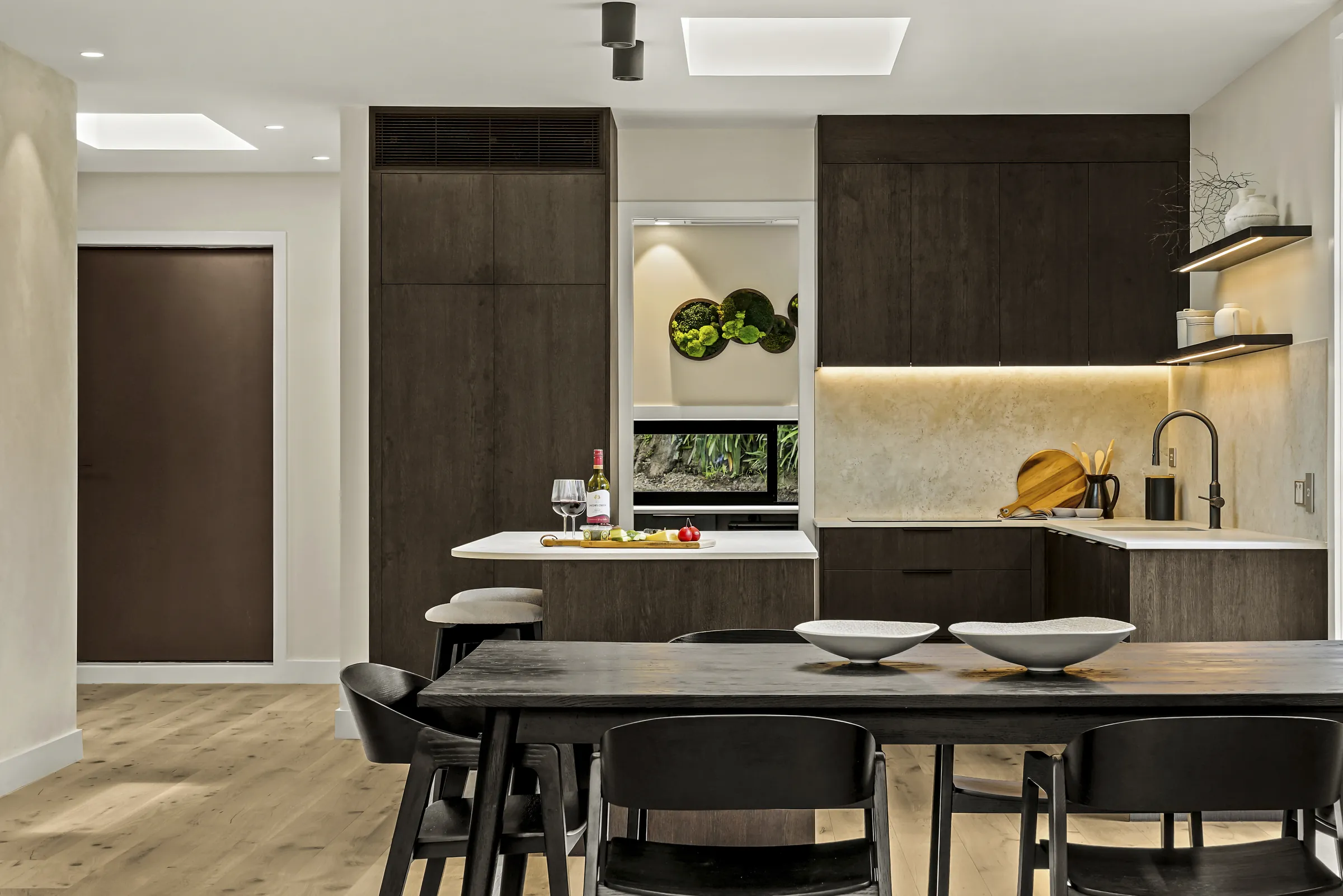
Built for the houses we actually live in.
Most Auckland homes built in the last forty years sit on a concrete slab, and the recorded rules for putting solid timber over one are not small print. BRANZ Bulletin 644 is the industry guidance, and it reads as a list of ways a solid floor gets hurt: the slab must dry for roughly a month per 25mm of thickness, around four months for a standard slab, and prove itself at 70 percent relative humidity or better before boards go near it. The boards must land inside NZS 3602’s installed moisture bands, which can mean 3 to 14 days acclimatising on site, stacked and monitored. The finished floor needs an 8 to 10mm gap at every wall, and once it passes six metres in either direction, movement control joints are cut through the field of the floor and filled with cork or sealant. Where any of that goes wrong, the bulletin names the results: cupping, buckling and boards popping.
An engineered glue-down shrinks that list rather than inheriting it. The slab still has to be dry, but the adhesive bed under every board is itself a moisture barrier; the crossed construction does the stabilising that solid timber asks the site to do; the floor runs continuous through an open plan with no joints cut across it; and underfloor heating is a published rating on our range pages, where the same BRANZ guidance warns that heated solid boards can gap, crack and warp. Timber floors in wet areas covers the moisture side of the glue-down system under the Building Code.
The same oak underfoot.
None of this costs you the thing people actually want from a timber floor. The surface of an engineered board is solid oak, the same material as the face of a solid plank, with real grain, knots and character, and no two boards alike. It arrives pre-finished under lacquer rather than raw, and the range is wider than solid timber ever offered here: rustic grade with all its character in ATS Timber, select grade French oak with long clean lengths in Oak Plank, and the same oak cut for pattern in Herringbone, across more than forty colours.
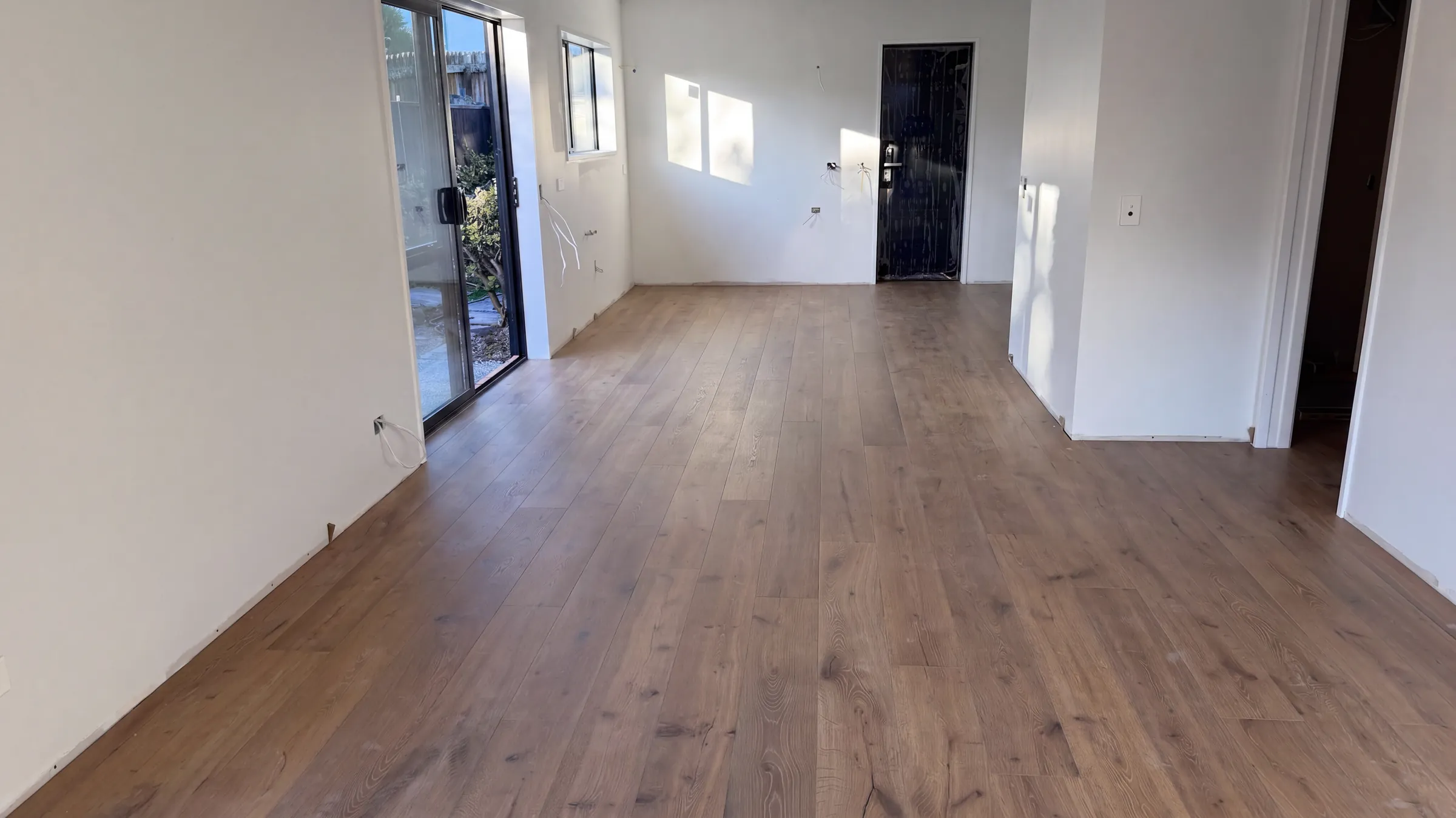
The sanding arithmetic.
The argument that keeps solid timber alive is sanding life: a thick board can be sanded again and again, a thin wear layer cannot. The numbers are smaller than the reputation. A 19 or 20mm solid board carries only about 6mm of oak above its tongue, and a sander has to stop well short of exposing it, so the realistic budget is four or five careful sands. A 4mm engineered wear layer banks two full re-sands with margin, because a professional re-sand removes between half a millimetre and a millimetre of timber.
Then ask how many sands a floor actually uses. A re-sand answers decades of wear; it is not a maintenance habit, and most floors collect one or two in their whole life. What makes a quality engineered timber board runs the same arithmetic across the market’s wear layers. The short version: the solid board’s advantage is two or three spare sands that almost no floor ever cashes in.
Four times the floor from the same tree.
There is also the oak itself. Slow-grown European oak is the expensive, finite part of any timber floor, and the two constructions spend it very differently. Cut into 4mm wear layers instead of 19mm boards, the same oak faces roughly four times the floor once the saw has taken its share, and the core beneath it is fast-growing plantation timber. That is a large part of why engineered oak costs less per square metre, and why it is the easier floor to defend environmentally.
The practical case, line by line.
Engineered boards arrive pre-finished, so the house is walkable the day the install finishes. A solid floor is laid raw, then sanded and coated on site: days of dust and fumes, and a home you cannot live in while it happens. Supply runs the same direction. Solid oak tongue and groove is a special order in New Zealand, while every engineered range we lay is a stocked product with a published supply and install rate, warranties to 25 years.
A solid floor’s quote is still growing after the boards are paid for: the sub-structure, the fixing labour, the sanding, the coating, and the week of trades those lines represent. What a floor really costs breaks down how an installed flooring quote is built, so the two paths can be compared on their finished numbers rather than their starting ones.
Where we land.
Engineered oak is more stable in New Zealand conditions, suits the slab-built houses we actually live in, carries the same solid oak underfoot, holds as many sands as any floor will realistically use, spends slow-grown oak four times as carefully, and goes in faster for less money. The one job where we still reach for solid timber is patching and matching an existing solid floor, because like repairs best with like. For a new floor, engineered is the better choice on every count we can measure, and it is not a close call.
Let’s start from the ground up.
Tell us about your space and we’ll come back with a plan and a price.